







On January 22, NASA will hold its annual Day of Remembrance and mark the solemn anniversaries of three of its most stunning tragedies. The memorial event, which takes place at the Kennedy Space Center Visitors Complex, honors all astronauts who have sacrificed their lives in pursuit of space exploration.

Photo Credit: NASA
Apollo 1 crew members, from left, Gus Grissom, Edward White and Roger Chaffee stand near Cape Kennedy’s Launch Complex 34 during training in January 1967.
The first of these tragedies occurred on January 27th, 1967, during a pre-flight test for the Apollo 1 mission that had been slated to launch February 21st, 1967. Astronauts Virgil “Gus” Grissom, Edward White and Roger Chaffee were inside the spacecraft as it sat on the launch pad at Cape Canaveral. Several hours and several problems into their launch rehearsal, a fire suddenly broke out in the spacecraft. Within seconds the command module ruptured, the fire quickly spread and the cabin filled with a lethal mixture of carbon monoxide, smoke and fumes. Because the hatch door could only open inward, a feat made impossible by the higher than atmospheric pressure inside the cabin, escape attempts were thwarted, and all three astronauts perished. The resulting investigation led to more than one thousand changes in the command module and launch pad procedures. These included a new quick-operating hatch design that opened outward; the use of an oxygen-nitrogen mix rather than 100 percent oxygen in the launch pad cabin atmosphere; a major reduction in flammable materials inside the spacecraft; and the addition of protective insulation to plumbing and wiring. Manned Apollo flights resumed in October 1968.

Photo Credit: NASA
In this photo from Jan. 9, 1986, the Challenger crew takes a break during countdown training at NASA’s Kennedy Space Center. Pictured from left are teacher-in-space Christa McAuliffe, Greg Jarvis, Judy Resnik, Francis “Dick” Scobee, Ron McNair, Michael Smith and Ellison Onizuka.
Almost 20 years after the Apollo 1 fire, tragedy rocked NASA again when on Jan. 28, 1986, the Space Shuttle Challenger broke up after liftoff killing all seven crew members. On launch day, media hype was high and classrooms across the nation were tuned in to watch live as the first teacher-astronaut, Christa McAuliffe, journeyed into space on the inaugural mission in NASA’s new Teacher in Space program. Just 73 seconds after liftoff, spectators at the site and around the world watched in horror as the shuttle broke up in a plume of smoke and fire. Although the crew cabin did make it through the initial break-up in tact, the impact from its high-velocity freefall into the Atlantic Ocean was too intense to survive. In addition to McAuliffe, those killed were Francis “Dick” Scobee, Ron McNair, Michael Smith, Ellison Onizuka, Judy Resnik and Greg Jarvis. Subsequent investigations concluded that the disaster was caused when an O-ring seal on the right solid rocket booster failed in the unusually frigid temperatures on the morning of the launch. NASA once again rallied to right the failures the accident tragically revealed, and the shuttle program resumed in 1988.

Photo Credit: NASA
STS-107 crew members pose for their traditional in-flight crew portrait aboard the Space Shuttle Columbia. From the left on the bottom row are Kalpana Chawla, Rick Husband, Laurel Clark and Ilan Ramon. From the left on the top row are David Brown, Willie McCool and Michael Anderson.
The shuttle program once again faced disaster on February 1, 2003, when the Space Shuttle Columbia was returning from a 16-day micro-gravity research mission. During re-entry, the shuttle disintegrated leaving its seven crew members dead and a debris field spread across Texas and Louisiana. Those who perished in the devastating accident were U.S. astronauts Rick Husband, Willie McCool, Michael Anderson, Kalpana Chawla, David Brown and Laurel Clark; and Israeli astronaut Ilan Ramon. Prior to the disaster, Columbia had a triumphant history that started in 1981 when it became the first Space Shuttle launched in the program. On January 16, 2003, Columbia set off on its 28th mission. During liftoff, a piece of insulating foam on the external fuel tank broke off and hit the shuttle’s left wing. Investigations following the accident determined that when the wayward foam struck the wing it caused a breach in the thermal protection that ultimately led to the spacecraft’s destruction.
Although these horrifying incidents occurred decades apart, they share a common legacy. Each was more than a grim reminder of the dangers of space exploration. Instead, they galvanized NASA to improve and drove the agency to persevere in its noble pursuit to discover the secrets of space.
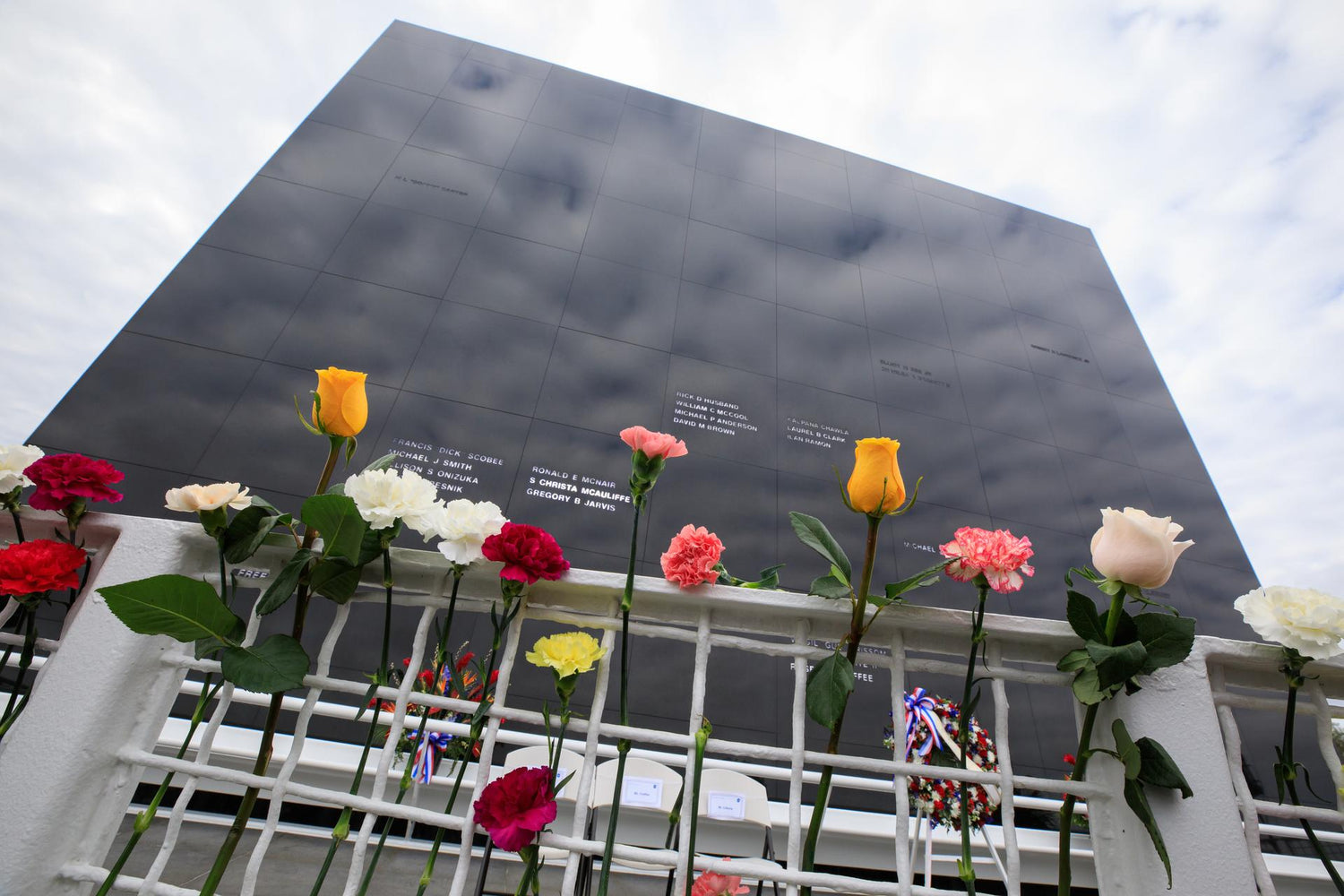
TOP IMAGE: Kennedy Space Center workers and guests placed flowers at the Space Mirror Memorial at the Kennedy Space Center Visitor Complex in Florida during NASA’s Day of Remembrance on Jan. 26, 2023. The event honored the crews of Apollo 1 and space shuttles Challenger and Columbia, as well as other astronauts who lost their lives in the pursuit of spaceflight. (Photo Credit: NASA/Kim Shiflett)


Leave a comment
All comments are moderated before being published.
This site is protected by hCaptcha and the hCaptcha Privacy Policy and Terms of Service apply.