







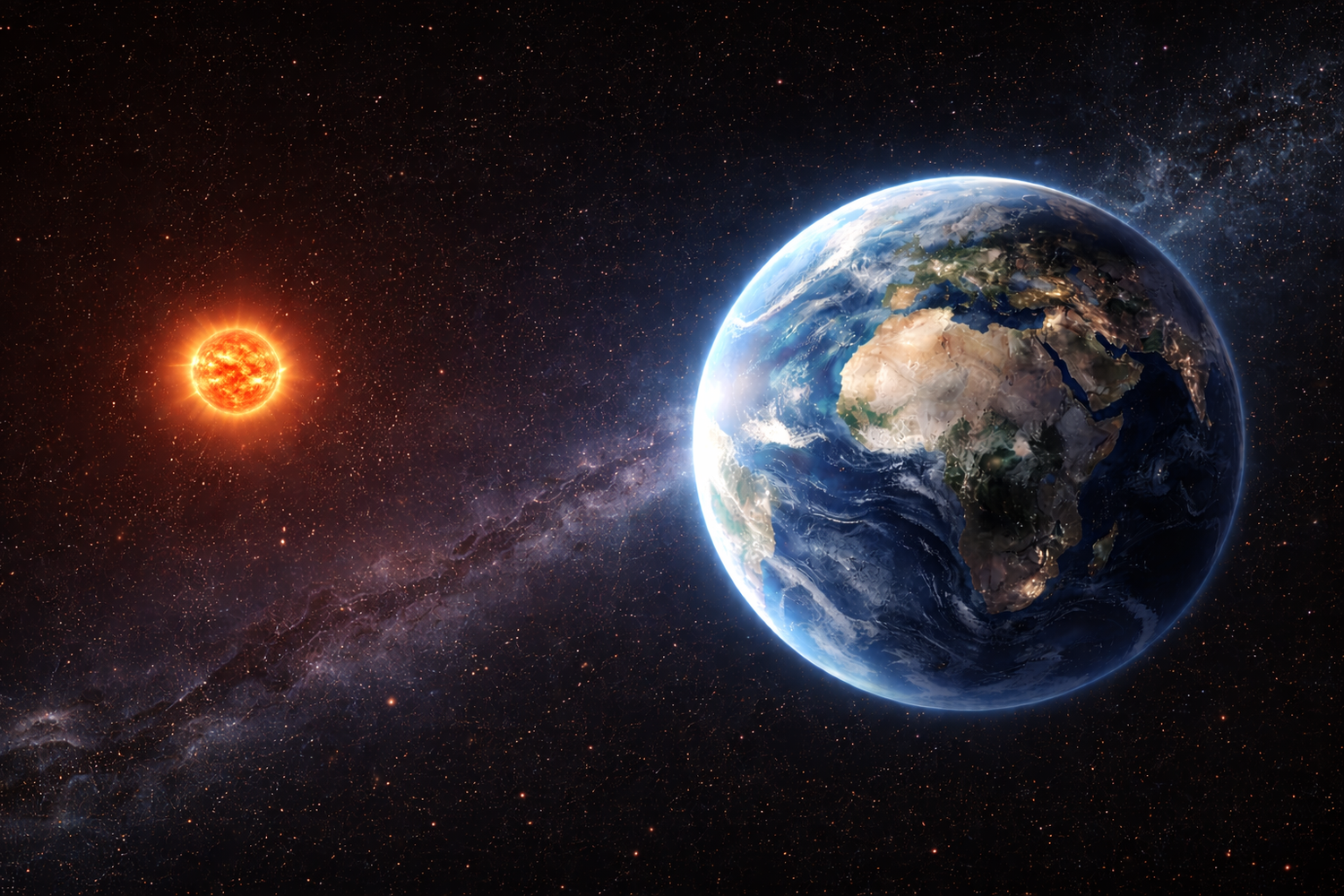
Each year, in the opening days of January, Earth reaches a precise and meaningful point in its journey around the Sun. This moment is called perihelion—the instant when our planet is closer to the Sun than at any other time during the year. In 2026, perihelion occurs on January 3 at approximately 17:15 UTC (12:15 p.m. Eastern Time).
For many of us in the Northern Hemisphere, this comes as a surprise. January feels distant from the Sun—cold air, long nights, bare trees, and winter skies. Yet at perihelion, Earth is about 147 million kilometers (91.4 million miles) from the Sun—roughly 5 million kilometers closer than it will be six months later in early July.
The lesson is simple, and profound: our instincts about the sky don’t always match the mechanics of the cosmos.
A Planet of Opposite Seasons
While winter defines January north of the equator, the Southern Hemisphere is living through summer.
At this time of year, regions south of the equator tilt toward the Sun, receiving higher sun angles and longer daylight hours. The result is warmth, extended days, and summer skies across Australia, South America, southern Africa, and parts of Antarctica’s coast.
Perihelion slightly amplifies this seasonal contrast. Because Earth is closest to the Sun during southern summer, the Southern Hemisphere receives a small but measurable increase in solar energy compared to the Northern Hemisphere’s summer in July.
This leads us to one of astronomy’s most important clarifications:
The seasons are not caused by Earth’s distance from the Sun.
Tilt, Not Distance, Shapes the Seasons
Earth’s seasons are governed by its 23.5-degree axial tilt.
In January, the Northern Hemisphere tilts away from the Sun. Sunlight arrives at a lower angle, spreading energy over a larger surface and producing cooler temperatures. At the same time, the Southern Hemisphere tilts toward the Sun, concentrating solar energy and bringing warmth.
Distance plays only a minor role. Tilt is the architect of the seasons.
Perihelion simply adds a subtle accent—making southern summers slightly brighter and northern summers slightly milder.
Moving Faster Around the Sun
There’s another effect at perihelion—one that speaks to motion and time.
As described by Kepler’s laws of planetary motion, Earth moves faster when it is closer to the Sun. Near perihelion, our planet travels at about 30.3 kilometers per second, compared to roughly 29.3 kilometers per second at aphelion. That difference—about 1 kilometer per second—adds up over time.
Because of this, Northern Hemisphere winters are a few days shorter than Southern Hemisphere winters. Over the course of a year, Earth averages about 107,000 kilometers per hour as it carries us together along our shared path around the Sun.
One Orbit, Many Skies
Perihelion itself offers no visible marker in the sky, but its effects are felt everywhere.
In January, Northern Hemisphere observers look up to winter constellations like Orion and Taurus, sharp and brilliant against cold night air. Meanwhile, Southern Hemisphere observers experience warm summer evenings beneath the Southern Cross, Carina, and the glowing sweep of the Milky Way.
- Different seasons.
- Different skies.
- One shared orbit.
Why Perihelion Isn’t Our New Year
From an astronomical perspective, perihelion is an elegant and exact marker of Earth’s motion, but it was never adopted as the beginning of the year. By the time Johannes Kepler precisely defined perihelion in the early 17th century, the calendar we still use today had already been established in 1582 under Pope Gregory XIII. That reform—guided by a team of scholars and astronomers, most notably Christopher Clavius—was designed to keep the seasons aligned with human life and tradition, not to track the subtleties of orbital geometry.
That’s because perihelion:
- Slowly shifts over time due to orbital changes,
- Doesn’t align with seasonal or cultural transitions worldwide,
- And offers no obvious visual cue for daily life.
Who Identified Earth’s Perihelion?
Earth’s perihelion wasn’t discovered in a single moment or by a single person.
It emerged through centuries of astronomical progress. Copernicus placed Earth in orbit around the Sun. Johannes Kepler revealed that planets follow elliptical paths and defined perihelion and aphelion. Isaac Newton later explained the physics behind these motions through gravity.
Of these, Kepler is most closely associated with identifying and describing perihelion scientifically.
A Moment of Perspective
January 3rd carries a remarkable symmetry. Earth is closest to the Sun while half the planet is wrapped in winter and the other half is immersed in summer. The same sunlight that feels distant and pale in the north arrives warm and direct in the south.
It’s a reminder that Earth is diverse, yet deeply connected.
Wherever you are—standing under winter stars or summer skies—you are part of the same graceful orbit, moving swiftly and faithfully around our star, closer to it now than at any other time of the year.


Leave a comment
All comments are moderated before being published.
This site is protected by hCaptcha and the hCaptcha Privacy Policy and Terms of Service apply.